


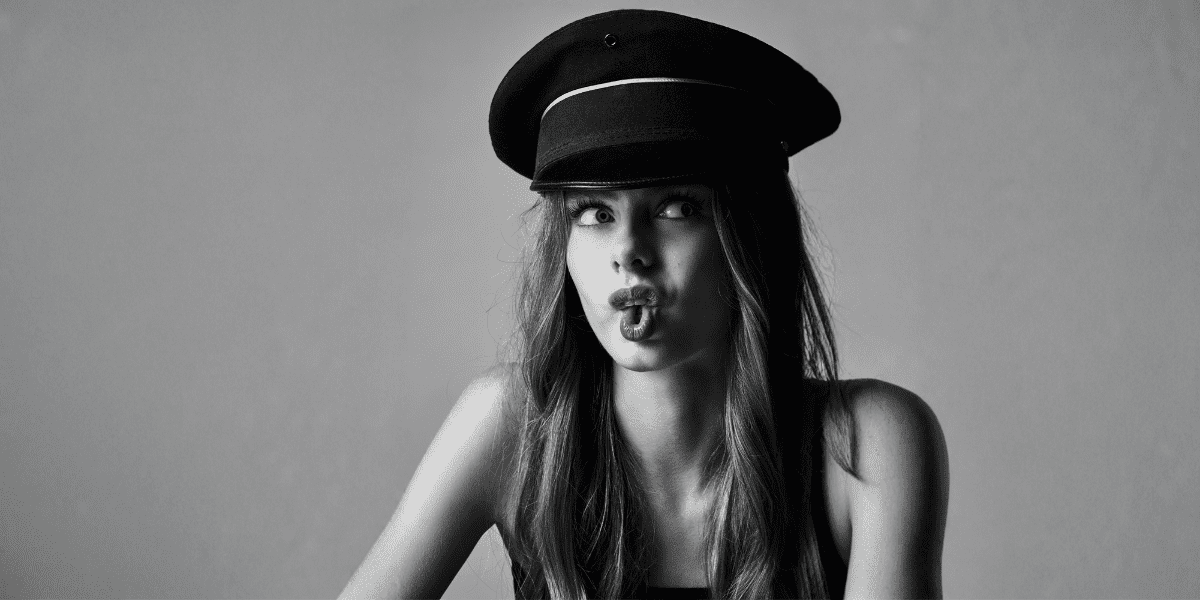
Photo Credit: Nelly Opitz, Management
A teenager’s struggle to tell the difference between a real girl and AI highlights a crisis in self-perception, seen through Nelly Opitz.
Los Angeles, CA – In today’s world, the line between reality and artificiality is increasingly blurred. A recent encounter with my teenage daughter highlighted this growing crisis. I showed her three photos, one of a synthetic TikTok influencer, one of an AI portrait, and one of Nelly Opitz, a real 15-year-old athlete from Germany. I asked her to identify which one was real.
After confidently selecting the AI-generated images, she hesitated when it came to Nelly’s photo. “I think… this one is fake,” she said before quickly adding, “Actually… I don’t know.”
That moment of uncertainty left me deeply concerned, not because she was mistaken, but because she doubted her own instincts. This hesitation reflects a deeper issue, one that’s at the intersection of teenage identity and digital perception.
Nelly Opitz is an accomplished athlete and model, with achievements that include being the German national rope-skipping champion in her age division. She’s also built a significant following on Instagram and TikTok, where her feed reflects the dedication and rigor of her sport.
Her athletic discipline gives her an almost sculptural appearance, a physique that, in the world of social media filters and heavily edited photos, might look out of place. The same discipline that shapes her body also leads some to question whether she is real. In fact, there has been growing speculation that she might be AI, not because she looks unnatural, but because her appearance is too consistent, too human, for a generation accustomed to algorithmically perfected images.
 Photo Credit: Nelly Opitz Management
Teenagers today live in a world dominated by filtered, edited images. These filters, however, are not just superficial, they’ve fundamentally altered how young people view themselves and others. Many teens see themselves as versions of themselves, constantly adjusting and editing their appearance to meet ever-shifting standards.
This creates what psychologists call “visual displacement”, a sense that a girl’s real face doesn’t match either the filtered images she projects or the enhanced versions of her peers. The result is confusion, self-doubt, and even shame.
The moment my daughter hesitated in identifying a real person, the moment she doubted her ability to discern what’s genuine, highlights a chilling reality: being real is no longer enough to be believed.
What frightens me isn’t that my daughter misidentified Nelly Opitz. It’s that she hesitated. She second-guessed herself. This growing distrust in one’s own perception is part of a larger cultural problem. Girls today are bombarded with unattainable standards of beauty and performance, often amplified by digital filters. They are expected to be perfect, and then prove that they didn’t cheat to get there.
When a real girl, like Nelly, is mistaken for an AI creation, the message to young people is clear: authenticity is no longer sufficient. They are growing up in a world where they are constantly told to question what is real, what is not, and what their own instincts tell them.
Opitz continues to post on social media, unaffected by the whispers of doubt. But her experience serves as a metaphor for a much larger issue. Girls today are struggling to reconcile their real selves with the digitally curated world they see online. And in doing so, they are losing the ability to trust themselves.
In this environment, we’ve forgotten to show young people what real life looks like. As a result, many are standing in front of mirrors, unsure of their own reflection.To explore more, you can follow Nelly Opitz on Instagram and TikTok.